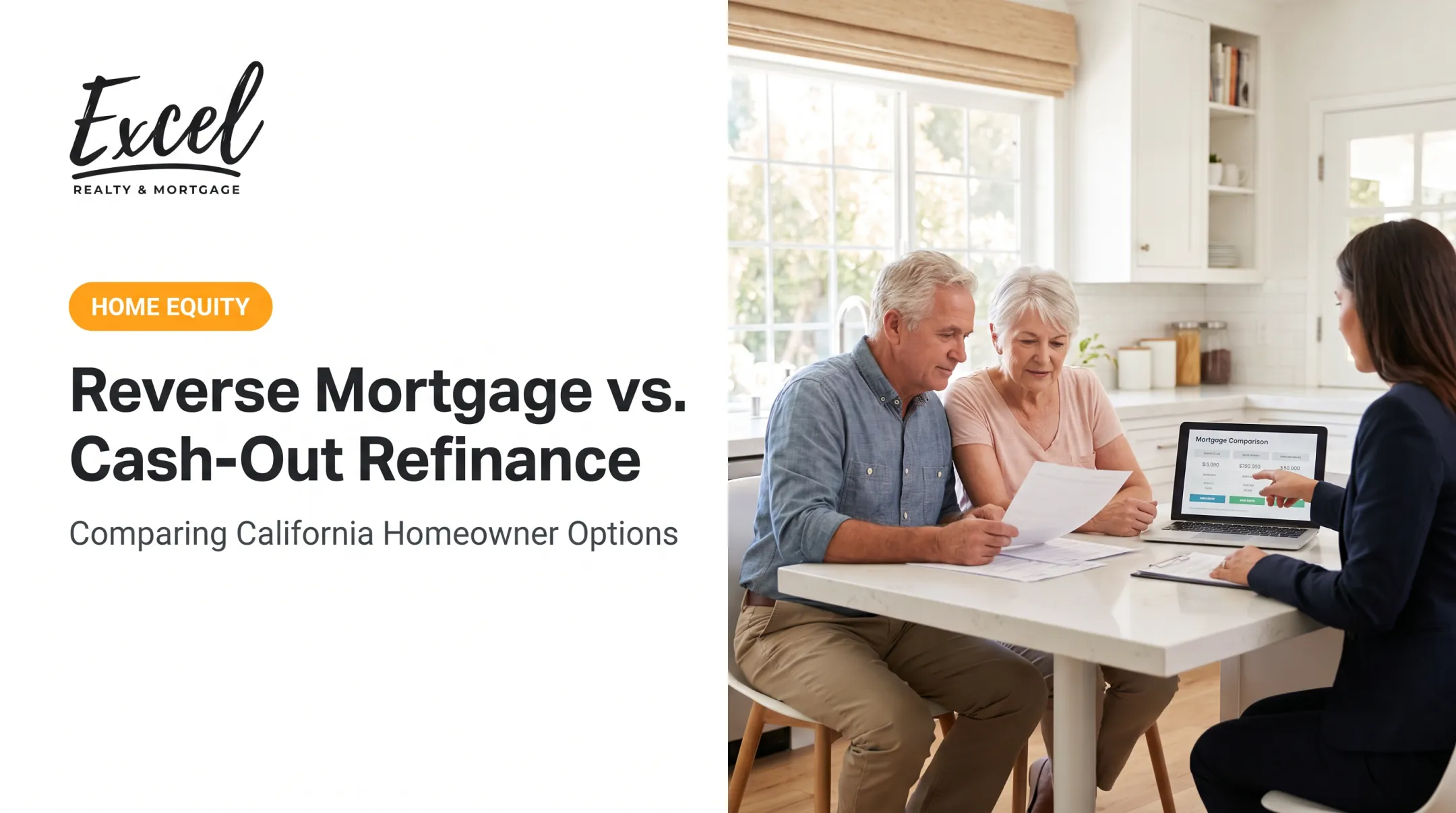

This choice matters more than most retirement decisions because it touches three things at once—your cash flow, your living situation, and your family's inheritance. Get it wrong, and you could end up house-rich but cash-poor, or cash-rich but uprooted from a home you love.
This article compares reverse mortgages and home sales side by side, then gives you a practical framework for deciding which fits your situation.
Key Takeaways
- Reverse mortgages let homeowners 62+ tap equity with no monthly payments while staying in the home
- Selling converts full equity into cash but means relocating and paying moving and closing costs
- Income needs, health, and estate goals should drive the choice—not just the math
- Downsizing? A reverse mortgage for purchase can fund the next home without a traditional loan
Reverse Mortgage vs. Selling: Quick Comparison
| Factor | Reverse Mortgage | Selling |
|---|---|---|
| Cost | Closing costs, mortgage insurance, ongoing taxes/insurance | Agent commissions, repairs, staging, moving costs |
| Access to cash | Lump sum, monthly payments, or line of credit | One-time lump sum from sale proceeds |
| Living situation | Stay in your current home | Must relocate |
| Inheritance impact | Reduces equity left to heirs over time | Preserves cash value that can pass to heirs |
The core tension is simple: a reverse mortgage trades future equity for present-day liquidity while letting you stay put. Selling trades your home for full liquidity right now.

Neither is inherently "better." It depends on what you value more: staying in a familiar place, or having maximum cash on hand today.
What Is a Reverse Mortgage?
A Home Equity Conversion Mortgage, or HECM, is the FHA-insured reverse mortgage most homeowners use. It's available to homeowners aged 62 and older, and it lets you convert a portion of your home equity into cash without giving up ownership.
Unlike a traditional mortgage, there's no required monthly payment. Instead, the loan balance grows over time and gets repaid when you sell, move out, or pass away.
Core Benefits
- No monthly mortgage payments required while you live in the home
- Non-recourse protection so you and your heirs never owe more than the home is worth at repayment (HUD Handbook 4000.1)
- Flexible disbursement as a lump sum, monthly payments, or a line of credit
Eligibility Basics
HUD sets these baseline requirements:
- Every borrower must be at least 62 at closing, with no maximum age limit
- The home must be your only principal residence, occupied within 60 days of closing
- Underwriting reviews credit history, existing liens, and your ability to keep up with property charges
Homeowners with higher-value properties should also know about proprietary or "jumbo" reverse mortgages. These are private loan products designed for homes that exceed standard FHA limits, though the specific terms vary by lender.

Use Cases of a Reverse Mortgage
A reverse mortgage tends to make the most sense for retirees who:
- Want to age in place rather than relocate
- Need supplemental income beyond Social Security
- Want funds available for home modifications or unexpected healthcare costs
Income and expenses rarely line up neatly in retirement. The average Social Security check was $2,029.92 per month as of mid-2026. Average annual household spending for ages 65-74 runs $54,440, including $22,329 on housing and $7,715 on healthcare (Kiplinger, 2026).
That gap between fixed income and real-world costs is what draws many retirees toward tapping home equity instead of a full sale.

Excel Mortgage Services' Chris Bonnema works with homeowners across California, Arizona, Texas, Oregon, and Florida to determine whether a reverse mortgage fits their retirement plan—or whether another option makes more sense.
What Is Selling Your Home?
Selling means listing your property, closing the sale, and using the proceeds to downsize, rent, or relocate somewhere new. It's the more straightforward path: you convert 100% of your equity into cash, minus typical selling costs such as agent commissions and closing fees.
Core Benefits
- Full equity access with no ongoing loan balance
- No maintenance, property taxes, or repair bills on that home
- Freedom to move closer to family or to a lower cost-of-living area
Some retirees sell and rent afterward, freeing up cash without new homeownership obligations. Others sell and buy a smaller home outright, eliminating monthly housing costs entirely.
Use Cases of Selling
Selling tends to fit best when you want to:
- Relocate to a new area or closer to family
- Downsize to cut home size and ongoing maintenance
- Capture gains in a strong local market
That last point is especially relevant now. Homeowners have gained more than $140,000 in average appreciation over the past five years (NAR, 2025).
The typical seller in 2025 was 64 years old, and the median time owners stayed before selling reached a record 11 years. Both figures show long-term homeowners are sitting on substantial, sellable equity.
Tax implications matter too. Under IRS rules, sellers can exclude up to $250,000 of gain ($500,000 for married couples filing jointly) if they owned and lived in the home for at least 24 months of the prior five years (IRS Publication 523). Gains above that threshold may be taxable, so check your numbers before assuming full proceeds are yours to keep.

Reverse Mortgage vs. Selling: Which Is Better for You?
There's no universal answer here. Weigh these factors:
- Do you want to stay in your home? If yes, a reverse mortgage keeps you there. If you're ready for a change, selling frees you to move.
- What are your income needs? A reverse mortgage provides ongoing liquidity without a lump-sum sale. Selling gives you one large payout upfront.
- What's your local market doing? Strong appreciation favors selling now. A soft market might favor staying and borrowing against equity instead.
- How's your health and mobility? Aging in place works better with a reverse mortgage. Anticipated care needs might push toward selling and moving closer to family or care facilities.
- What are your estate goals? Selling preserves cash for heirs. A reverse mortgage gradually reduces the equity left behind.
General rule of thumb: Choose a reverse mortgage if you want to stay put and need steady supplemental income. Choose selling if you want to relocate, simplify your life, or maximize what you leave to heirs.
The Hybrid Option
If you want to downsize but avoid monthly mortgage payments on the new place, a reverse mortgage for purchase lets you sell your current home and buy a new one with reverse mortgage financing. You make no monthly payments on the replacement home.
A reverse mortgage specialist can help you determine whether this structure fits your downsizing goals.
Real-World Example
Bill and Maureen Deller, a couple in their mid-seventies near Tucson, had a home appraised at $280,000 and qualified for a reverse mortgage line of credit worth nearly $172,000 (Kiplinger, 2017).
They weren't in financial distress. They described the reverse mortgage as "a kind of insurance policy," a safety net they could tap if needed without disrupting their current life. That's a common pattern among retirees: using a reverse mortgage line of credit as backup funds rather than waiting for a crisis.
The takeaway: you don't need to be in crisis to consider a reverse mortgage. Sometimes it's simply about having options available before you need them.
If you're weighing a similar decision, a conversation with an Excel Mortgage Services loan officer can help clarify whether a reverse mortgage, a sale, or some combination fits your specific goals.
Conclusion
There's no single right answer when choosing between a reverse mortgage and selling your home. The better fit depends on your lifestyle goals, income needs, and whether you want to preserve equity for your heirs.
Before you decide, talk with a mortgage professional or financial advisor who can run your specific numbers. Excel Mortgage Services offers personalized guidance to help you compare both options clearly—without pressure to pick one path over the other.
Frequently Asked Questions
What do financial experts say about reverse mortgages?
Reverse mortgages can work well for retirees who have substantial home equity and rely on fixed income. Review long-term costs with your family before you commit.
Can I sell my home if I already have a reverse mortgage?
Yes. You can sell at any time. The loan is repaid from the sale proceeds, and non-recourse protection means you never owe more than the home’s value.
Is a reverse mortgage a good idea if I plan to leave my home to my children?
Reverse mortgages reduce the equity left for heirs because the loan balance grows over time. If maximizing inheritance is your top priority, selling is usually the stronger fit.
What happens to a reverse mortgage when the homeowner dies?
Heirs can repay the loan, sell the home, or in some cases refinance it. Non-recourse protection means they'll never owe more than the home's appraised value, regardless of the loan balance.
How do I know if I have enough equity for a reverse mortgage?
Lenders weigh your age, home value, and any existing mortgage balance to calculate available proceeds. A reverse mortgage loan officer can run your numbers and show what you may qualify for.
Can I combine selling and a reverse mortgage?
Yes. A "reverse mortgage for purchase" lets you sell your current home and buy a new one using reverse mortgage financing, avoiding monthly payments on the replacement property.